

Words by Justin Turford
“I had a dream that I was in a forest, and I was looking for a tree to make an instrument. Then I saw my great grandfather, and he handed me the perfect piece of wood.. When I woke up, I knew I had to follow music.”
Reflections on family, grief, love, tradition and courage make up this exceptional debut album from the young Ghanaian multi-instrumentalist and seperewa player Nana Osei Twum Barima. It is also a story of an immigrant’s journey - ‘to the unknown’.
At the heart of Nana’s tale is his family’s ties with the ancient Ghanaian harp-lute, the seperewa - a multi-stringed instrument played with the thumbs or bow, it differs from similar instruments such as the kora by having the neck attached to a square box resonator and not the typical calabash shape. His great-grandfather Kwabena Agyarko is regarded as a key figure in the revival of the seperewa after the British colonisers left, and his musician uncle Osei Korankye is a seperewa instructor at university. If that wasn’t enough proof of his family’s musical calibre, his grandmother Abena Korankyewa was a serious musician herself and when Nana finally decided to pursue music professionally despite his initial ambitions of becoming a geological engineer, it was she that encouraged him the most - “When I told her I wanted to continue with seperewa, she told me, ‘Now I can die in peace,’ and then she blessed me,” he remembers. “She started recording stuff for me, because she wanted to give me all the information before she died.”
Shadowed by the death of his father when Nana was just a teen and after a period of music education, he took the courageous decision to move away and found himself in Belgium, his new home. Loss continued to follow him as he struggled to find his place in this new country far from home with only his instruments for comfort. A few friends from Ghana passed away, as did his beloved grandmother, Nana’s mother becoming his chief encouragement to stay and persevere. And persevere he has. Channeling his struggles and pain into music, the young man should be proud of his resilience and daring for his debut album for the excellent Belgian label, Zephyrus Records, is as accomplished as it is fearless.
“I’m keeping the (seperewa) tradition, but also playing it my way”.
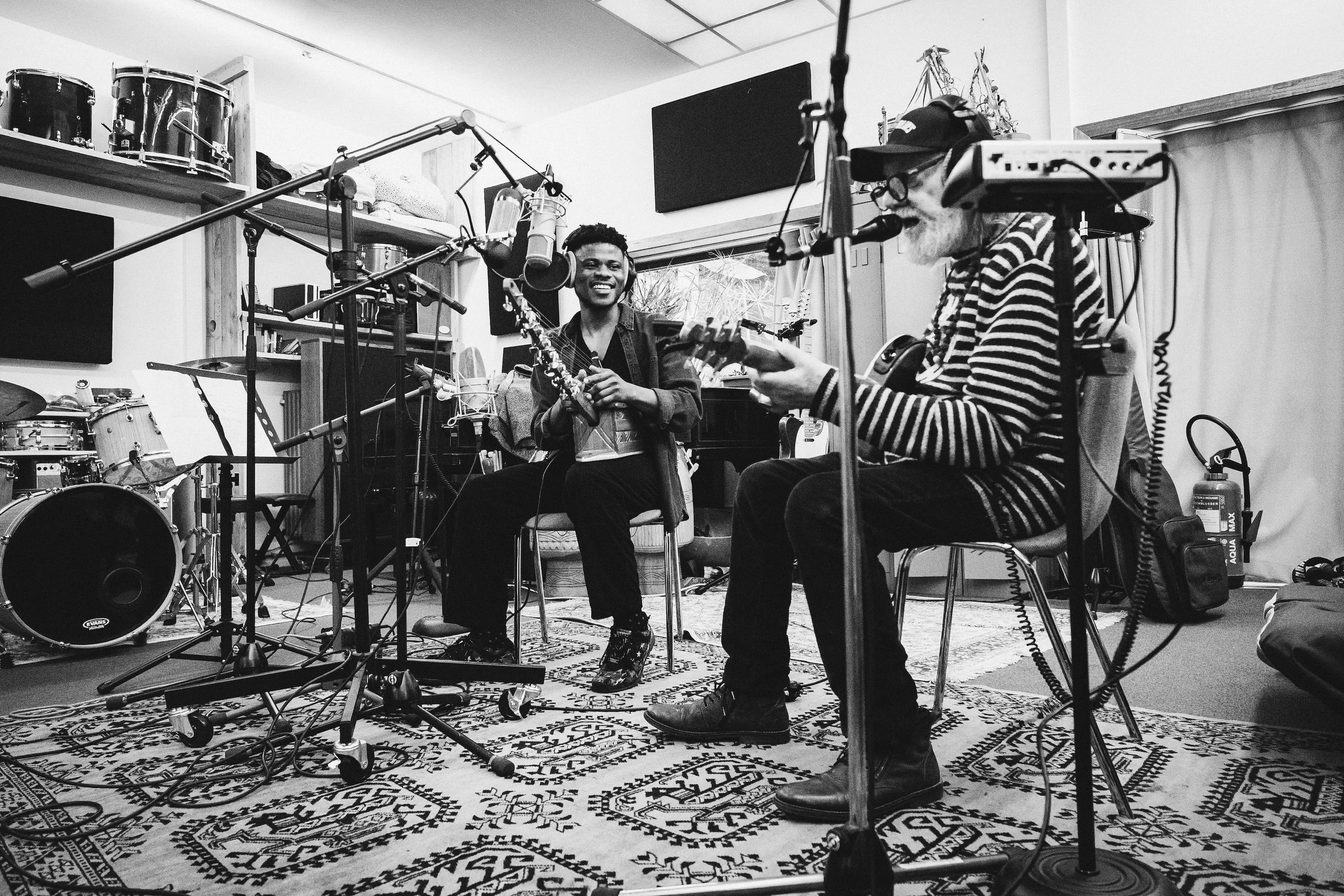
Nana Osei Twum Barima & Roland Van Campenhout ©Laurens-Wille
From northwestern Ghana to northwestern Europe, the feeling of displacement must have been intense for the young musician but he has carried his roots carefully with him. Traditional Ghanaian rhythms such as Kunduma and Nwomkro, the dialects of his region and of course, the lyrical melodies wrought from his seperewa form the foundations of his beautifully realised acoustic songs. And then there is Nana’s stunning tenor vocals. A young man’s voice but bruised amongst its bright, ringing tone, a voice that can be cheerful, can express deep sadness but also give praise, and it is praise that opens the album.
‘Mpaebo’ translates as ‘prayers’ and Nana gives thanks, praise and some darker requests to his god on this truly lovely opening song sung in the Twi dialect. The dance between his vocals and seperewa is just sublime. Bluesy, folky melodies spring from the strings of the harp-lute, his eloquent voice is joined by his own backing vocals as he sings of gratitude and love but also a request for pepper to sprinkle in the eyes of his enemies so they can also feel his pain. One certainly can’t deny Nana’s openness.
Featuring the Belgian fusion sitar player Nicolas Mortelmans, ‘Message to My Ancestors’ is a heartfelt plea of disappointment at the hardships of becoming an adult. Mortelman’s sitar drones and rings over a lower register layer of Kofi Nkansah-Boakye’s bass and a groaning goje fiddle, while Nana delivers a tightly arranged call-and-answer vocal that strongly reminds me of a Fela Kuti tune that I just can’t place. It’s an amazing example of Nana’s songwriting and storytelling abilities, and of how he is willing to develop upon the traditions he grew up with.
One of the first songs his grandmother taught him, ‘Owea’ sees Nana playing the seperewa in a more directly traditional way. Accompanied by clattering, ticking stick percussion and the dondo talking drum, he sings sweetly of the wisdom and warnings of the owl, ‘Owea’ in the Akan language (Twi is a dialect of this language).
Another great example of his willingness to test himself is on his excellent ode to the lowland weather of his new home on ‘Belgium and Rain’. On his first day in the country, he found himself stuck at Brussels Central in the pouring rain, despair and fear not far away. Over time he realised he needed to love the wet weather as he would love his new home, Ghent, a city also home to the 81-year-old Flemish blues veteran Roland Van Campenhout, who delivers a serene spoken word piece in English. Sounding strikingly like a more benign William Burroughs, he talks of rain and resilience as Nana layers his vocals (and languages) over a perky groove of banjo-esque seperewa and sitar inflections. A standout track that should hopefully catch the ears of the more Anglophone listeners.
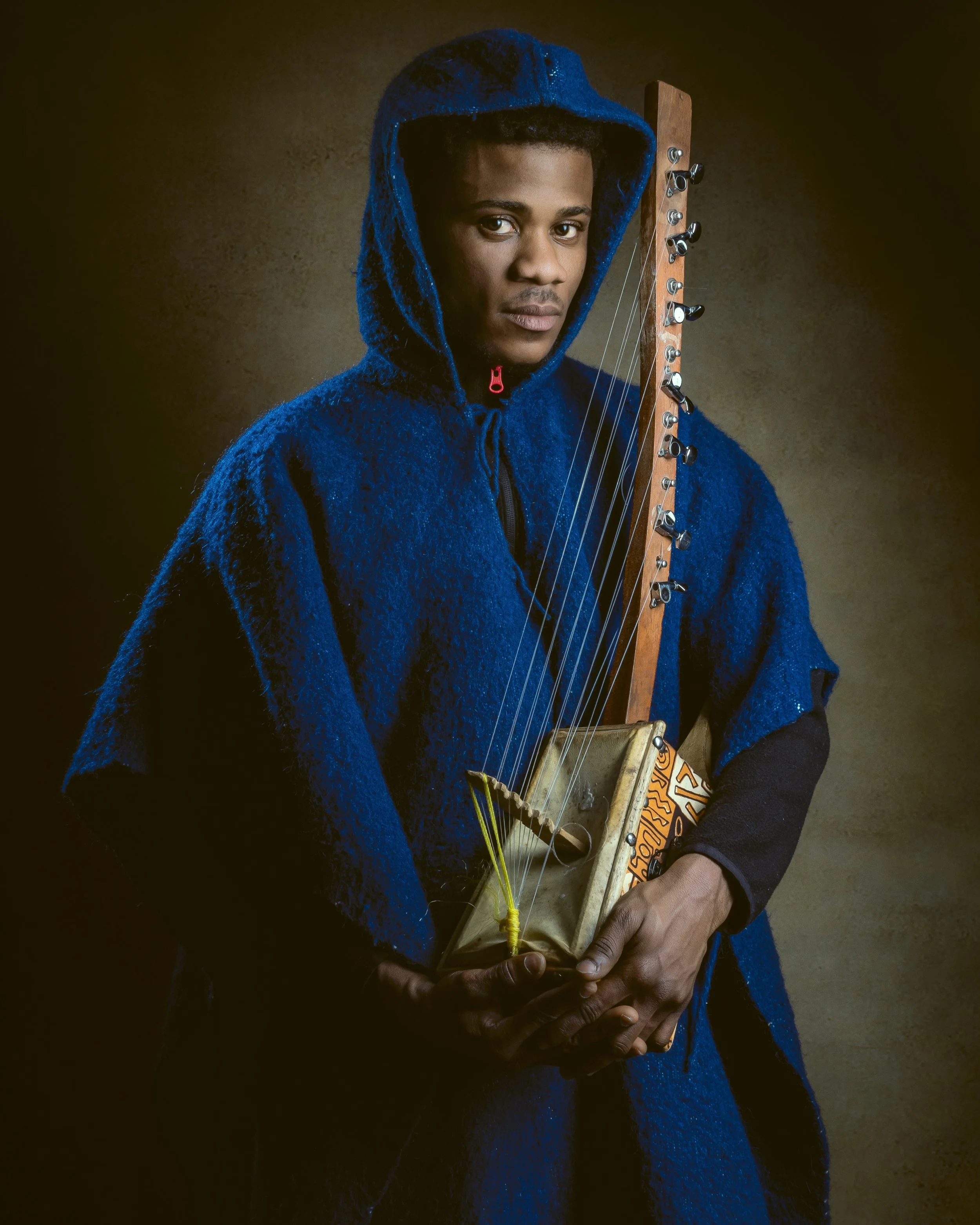
Photo © Shalan Alhamwy
His exhilarating tribute to his grandmother picks up the pace. ‘Moni’ means grandmother in Sefwi and it is in this dialect that he calls out to her, his loss audibly palpable, Nana’s voice straining over a vividly painted musical accompaniment of Lara Rosseel’s double bass, a circular ringing seperewa line and a highly expressive percussion bed of dondo drum, dawuro bell and shakers. Untamed and emotional, one can feel his complicated feelings of love and grief.
Until When’ is the most obviously political track on the record as he looks back at an idyllic childhood of healthy living and a healthy natural environment now destroyed by mining and government corruption. Joined by the Burkina Faso born griot Kaito Winse on his peul flute, the songs begins with the pastoral sounds of the village, Nicolas Mortelmans throwing out flashes of melody on his sitar, before Nana’s string playing and voice transforms from a gentle coo to a near scream like the land itself transmitting its despair. Even if you are unable to follow the lyrics, one can sense something is wrong as the musicians shriek in unison.
Another song of disappointment encased in a thing of beauty, ‘Akwalaba’ is sung from a mother’s point of view to her ‘little child’, her sadness at her child’s inability to do better sung with energy over a pulsing groove of tick-tocking percussion and seperewa.
Happier thoughts are shared on the duelling seperewa track ‘Odo’, a song of love and gratitude to his Uncle Osei Korankye who accompanies Nana on the tune on both vocals and harp-lute. A song about love, togetherness and family, it’s a charming, folksy piece of music.
A message song that is as much regret and sadness as it is good advice, the beautiful ‘Nipa’ is a pained apology to his father for not loving him enough whilst he lived and a call to us all to not make the same mistake. Accompanied by a heartwrenching violin, Nana never sounds as young on the album as he does here, forever the teenage son to his father. Exquisite seperewa picking is joined by measured percussion, a slow and steady groove of deeply felt emotions that closes the album with a penetrating yet calming profundity.
‘Journey to the Unknown’ is an extraordinary debut album for such a young man to make. His trials are laid bare on these deeply emotional songs and it’s impossible to not feel moved by what life has thrown at him but it is his resilience and the courage to transplant himself far from Ghana and expand upon his musical traditions that is the real story here. Nana is a serious talent to keep an eye on because if this is how he begins then only he knows what he can achieve in the future. 9/10.
BUY HERE! https://nanaoseitwumbarima.bandcamp.com/album/journey-to-the-unknown